This product is no longer available. Some accessories, replacement parts, or services may still be available.
| Services Available |
|---|
Overview
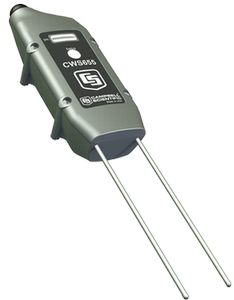
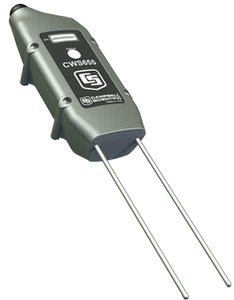
The CWS655A is a wireless version of our CS655 soil water reflectometer. It has 12 cm rods and monitors soil volumetric water content, bulk electrical conductivity, and temperature. This reflectometer has an internal 922 MHz radio that transmits data to a CWB100A Wireless Base Station or to another wireless sensor. The 922 MHz frequency is used in Australia, Israel, and other countries worldwide.
Read More
Benefits and Features
- Versatile sensor—measures dielectric permittivity, bulk electrical conductivity (EC), and soil temperature
- Measurement corrected for effects of soil texture and electrical conductivity
- Internal frequency-hopping, spread spectrum radio provides longer range and less interference
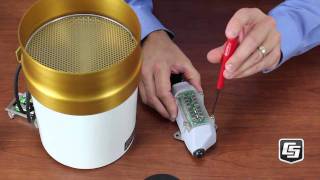
- Battery powered
- A reliable, low maintenance, low power method for making measurements in applications where cabled sensors are impractical or otherwise undesirable
- Transmissions can be routed through up to three other wireless sensors
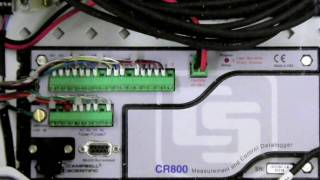
- Compatible with CR800, CR850, CR1000, and CR3000 data loggers
Images
Detailed Description
The CWS655A has 12-cm rods that insert into the soil. It measures propagation time, signal attenuation, and temperature. Dielectric permittivity, volumetric water content, and bulk electrical conductivity are then derived from these raw values.
Measured signal attenuation is used to correct for the loss effect on reflection detection and thus propagation time measurement. This allows accurate water content measurements in soils with bulk ≤3.7 dS m-1 without performing a soil-specific calibration.
Soil bulk electrical conductivity is also derived from the attenuation measurement. A thermistor in thermal contact with a probe rod near the epoxy surface measures temperature. Horizontal installation of the sensor provides accurate soil temperature measurement at the same depth as the water content measurement. For other orientations, the temperature measurement will be that of the region near the rod entrance into the epoxy body.
Why Wireless?
There are situations when it is desirable to make measurements in locations where the use of cabled sensors is problematic. Protecting cables by running them through conduit or burying them in trenches is time consuming, labor intensive, and sometimes not possible. Local fire codes may preclude the use of certain types of sensor cabling inside of buildings. In some applications measurements need to be made at distances where long cables decrease the quality of the measurement or are too expensive. There are also times when it is important to increase the number of measurements being made but the datalogger does not have enough available channels left for attaching additional sensor cables.
Compatibility
Please note: The following shows notable compatibility information. It is not a comprehensive list of all compatible products.
Specifications
| Weather Resistance | IP67 rating for sensor and battery pack (Battery pack must be properly installed. Each sensor is leak tested.) |
| Operating Temperature Range | -25° to +50°C |
| Operating Relative Humidity | 0 to 100% |
| Power Source | 2 AA batteries with a battery life of 1 year assuming sensor samples taken every 10 minutes (Optional solar charging available.) |
| Average Current Drain | 300 μA (with 15-minute polling) |
| Rod Length | 12 cm (4.7 in.) |
| Dimensions | 14.5 x 6 x 4.5 cm (5.7 x 2.4 x 1.77 in.) |
| Weight | 216 g (7.6 oz) |
Measurement Accuracies |
|
| Volumetric Water Content | ±3% VWC typical in mineral soils that have solution electrical conductivity ≤ 10 dS/m. Uses Topps Equation (m3/m3). |
| Relative Dielectric Permittivity |
|
| Bulk Electrical Conductivity | ±(5% of reading + 0.05 dS/m) |
| Soil Temperature | ±0.5°C |
Internal 25 mW FHSS Radio |
|
| Frequency | 920 to 928 MHz |
| Where Used | Australia and New Zealand |
| FHSS Channel | 50 |
| Transmitter Power Output | 25 mW (+14 dBm) |
| Receiver Sensitivity | -110 dBm (0.1% frame error rate) |
| Standby Typical Current Drain | 3 μA |
| Receive Typical Current Drain | 18 mA (full run) |
| Transmit Typical Current Drain | 45 mA |
| Average Operating Current | 15 μA (with 1-second access time) |
| Quality of Service Management | RSSI |
| Additional Features | GFSK modulation, data interleaving, forward error correction, data scrambling, RSSI reporting |
Documents
Brochures
Miscellaneous
Downloads
Wireless Sensor Planner v.1.7 (30.5 MB) 08-08-2013
The Wireless Sensor Planner is a tool for use with Campbell Scientific wireless sensors. It assists in designing and configuring wireless sensor networks.
Frequently Asked Questions
Number of FAQs related to CWS655A: 17
Expand AllCollapse All
-
No. The equation used to determine volumetric water content in the firmware for the CWS655 is the Topp et al. (1980) equation, which works for a wide range of mineral soils but not for organic soils. In organic soils, the standard equations in the firmware will overestimate water content.
When using a CWS655 in organic soil, it is best to perform a soil-specific calibration. For details on performing a soil-specific calibration, refer to “The Water Content Reflectometer Method for Measuring Volumetric Water Content” section in the CS650/CS655 manual. A linear or quadratic equation that relates period average to volumetric water content will work well.
-
No. The abrupt permittivity change at the interface of air and saturated soil causes a different period average response than would occur with the more gradual permittivity change found when the sensor rods are completely inserted in the soil.
For example, if a CWS655 was inserted halfway into a saturated soil with a volumetric water content of 0.4, the probe would provide a different period average and permittivity reading than if the probe was fully inserted into the same soil when it had a volumetric water content of 0.2.
-
Because the reported volumetric water content reading is an average taken along the entire length of the rods, the sensor should be fully inserted into the soil. Otherwise, the reading will be the average of both the air and the soil, which will lead to an underestimation of water content. If the sensor rods are too long to go all the way into the soil, Campbell Scientific recommends inserting the rods at an angle until they are fully covered by soil.
-
No. It is not possible to disable the logical tests in the firmware. If soil conditions cause frequent NAN values, it may be possible to perform a soil-specific calibration that will provide good results.
If permittivity is reported but the volumetric water content value is NAN, Campbell Scientific recommends a soil-specific calibration that converts permittivity to water content. This will take advantage of the bulk electrical conductivity correction that occurs in the firmware.
If both permittivity and volumetric water content have NAN values, it may be possible to perform a calibration that converts period average directly to volumetric water content.
For details on performing a soil-specific calibration, refer to “The Water Content Reflectometer Method for Measuring Volumetric Water Content” section in the CS650/CS655 manual. After a soil-specific equation is determined, it may be programmed into the data logger program or used in a spreadsheet to calculate the soil water content.
-
A thermistor is encased in the epoxy head of the sensor next to one of the stainless-steel rods. This provides a point measurement of temperature at the soil surface. The temperature measurement is not averaged over the length of the sensor rods.
-
Only the rods of the CWS655A should be buried. The body of the CWS655A was not designed for burial, and Campbell Scientific does not recommend burying it for the following reasons:
- While the body of the CWS655A is underground, the radio signal is diminished, and the soil must be disturbed to replace the batteries.
- Eventually, corrosion of the pins occurs where the battery pack connects. Sometimes moisture gets into the sensor electronics and causes irreparable damage.
If a wireless option is desired for fully buried water content sensors, consider using a CR200X-series datalogger with CS650-L or CS655-L cabled sensors.
-
The CWS655 works best when the rods are inserted into the soil as parallel to each other as possible. To make parallel pilot holes before installation, use the CS650G Rod Insertion Guide Tool. Minor deflection of a rod during insertion, such as when it contacts a small stone or root, may not affect the readings significantly. Major deflections, however, may cause the CWS655 to operate outside of published accuracy specifications, as well as to damage the sensor housing.
-
To get accurate water content readings, a soil-specific calibration is probably required if any of the following are true:
- The soil has more than 5% organic matter content.
- The soil has more than 20% clay content.
- The soil is derived from volcanic parent material.
- The soil has porosity greater than 0.5.
For details on performing a soil-specific calibration, refer to “The Water Content Reflectometer Method for Measuring Volumetric Water Content” section in the CS650/CS655 manual.
Some users have obtained good results by applying a linear correction to the square root of reported permittivity before applying the Topp et al. (1980) equation. The linear correction is obtained by taking readings in saturated and dry soil and using volumetric water content measurements obtained from oven-dried soil samples to estimate actual permittivity.
-
If information is available on soil texture, organic matter content, and electrical conductivity (EC) from soil surveys or lab testing of the soil, it should be possible to tell if the soil conditions fall outside the range of operation of the CWS655. Without this information, an educated guess can be made based on soil texture, climate, and management:
- Mineral soils work well with a CWS655 if the EC at saturation is below 3.04 dS/m.
- If the soil is located in an arid or semiarid region, it may have high EC.
- If the soil is frequently fertilized or irrigated with water that has higher EC, it may have high EC.
- If the climate provides enough rain to flush accumulated salts below the root zone, the EC is expected to be low and suitable for a CWS655.
- Organic or artificial soils typically have high surface electrical conductivity and may become out-of-bounds if they receive significant fertilizer or water with high EC.
-
Probably not. The principle that makes the CWS655 work is that liquid water has a dielectric permittivity of close to 80, while soil solid particles have a dielectric permittivity of approximately 3 to 6. Because the permittivity of water is over an order of magnitude higher than that of soil solids, water content has a significant impact on the overall bulk dielectric permittivity of the soil. When the soil becomes very dry, that impact is minimized, and it becomes difficult for the CWS655 to detect small amounts of water. In air dry soil, there is residual water that does not respond to an electric field in the same way as it does when there is enough water to flow among soil pores. Residual water content can range from approximately 0.03 in coarse soils to approximately 0.25 in clay. In the natural environment, water contents below 0.05 indicate that the soil is as dry as it is likely to get. Very small changes in water content will likely cause a change in the CWS655 period average and permittivity readings, but, to interpret those changes, a very careful calibration using temperature compensation would need to be performed.
Privacy Policy Update
We've updated our privacy policy. Learn More