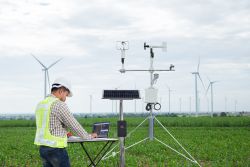
Services and Support to Meet Your Needs
Campbell Scientific provides a range of services to help you select, install, configure, and commission your monitoring system.
Visit our Services and Support web page to learn more.

How We Can Help You
Campbell Scientific turn-key systems for wind-resource assessment and power performance are specifically designed to meet the requirements of IEC 61400-12-1. These systems have a wide range of options for measuring wind speed, wind direction, air density, and electric power. Real-time or interval data are stored locally on the data logger, and can be transmitted via all standard communication methods.
Learn moreTo see how our systems meet your application needs, review our case studies »


Instrumentation
We offer a variety of products that can be used to create systems for Wind Energy. Many of the major components used to create these systems are listed below. Please let us know if we can help you configure a system.
More Details about Our Wind Energy Systems
Application: Wind Resource Assessment (WRA)
Finding a site with the resources to develop a wind farm is key to the success of the farm’s energy output. Developers dedicate a lot of time to determine the best process and equipment to assess a location’s suitability. To do so, they need a system tower to measure wind speed, wind direction, temperature, and pressure at multiple heights. These elements ensure that assessment data is continuous and consistent to determine the best site. If developers don’t have access to measurements at multiple heights, they risk data accuracy or could lose data if one sensor drops out. Wind farms located off the grid benefit from having remote-communication capabilities to observe measurement collection while not physically on-site. Campbell Scientific’s instrumentation, data loggers, and communications solutions can create a complete WRA solution that equips developers with the tools to secure reliable data and assess their desired wind resource site.
Data Loggers used in Wind Monitoring
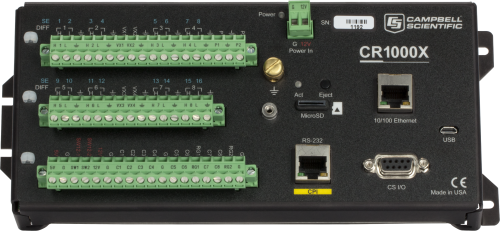
Our data loggers can be used for many different purposes. They can make and record measurements, control electrical devices, or both. The data loggers' multifaceted capabilities include functioning as PLCs or RTUs. They have many different channel types, allowing nearly all sensor types to be measured on a single unit. For example, one data logger can measure strain on turbine blades, wind speed, and power output of the turbine, even while controlling peripheral devices. The CR1000 with an LLAC4 peripheral can measure up to 10 low-level ac output anemometers. If long cable runs are being avoided, our CR200X-series data loggers can be deployed in a wireless network configuration, allowing cost effective monitoring at each level of a wind assessment tower.
The reliability of our data logger systems ensures data collection, even under adverse conditions. Wide operating temperature ranges and weather-proof enclosures allow our systems to operate reliably in harsh environments. Because they have their own power supply (batteries, solar panels), our data loggers continue to measure and store data and perform control during power outages. Up to 2 million data points can be stored in the data logger's non-volatile memory, while CompactFlash cards can be used to increase data storage to tens of millions of points. Data is time- and date-stamped to provide key information for identifying and analyzing past events.
Measurement Capabilities
Channel types include analog (single-ended and differential), pulse, switched excitation, and digital. Not only are there multiple types of input channels, but each of these channels can be independently programmed for various sensor types. Most sensors connect directly to the data logger, eliminating the need for external signal conditioning. Multiplexers and other peripherals can be used with most of our data loggers to increase the numbers and types of channels.
Control Capabilities
The ability of our data loggers to perform advanced control functions is a great advantage. Powerful on-board instruction sets allow unattended measurement and control decisions based on time or conditional events. Using these instruction sets, data loggers can be programmed to perform multiple control functions based on different scenarios. For example, alarms can be triggered, phone numbers dialed, or equipment shut down if the system detects an equipment failure--all without human intervention.
Wind Monitoring Sensors
Almost any sensor can be measured by our data loggers, allowing the wind energy system to be customized for each application. Typical sensors include, but are not limited to: sonic anemometers, 3-cup and propeller anemometers, wind vanes, temperature sensors (air, water, equipment, and product), solar radiation, electrical current, resistance, power, and voltage.
Communications
The availability of multiple telecommunications and on-site options for retrieving data or reporting site conditions also allows our systems to be customized to meet exact needs. Options include: radio, telephone, cellphone, voice-synthesized phone, satellite, and Ethernet. Systems can be programmed to send alarms or report site conditions by calling out to computers, phones, radios, and pagers.
Software
Our PC-based support software simplifies the entire data acquisition process, from programming to data retrieval to data display and analysis. Our software automatically manages data retrieval from networks or single stations. Robust error-checking ensures data integrity. We can even help you post your data to the Internet.
If you need assistance selecting the best wind sensor, tower, telecommunications, and data logger combination, please contact us. We'd be happy to answer your questions and provide the most cost-effective solution for your needs.
If you would like to view your options for wind speed sensors, please visit our sensor pages or contact us.
Case Studies
China is making strides in the global wind energy market, especially when it comes to......read more
Severe Tropical Cyclone Debbie was a category 4 system that made landfall near Airlie Beach......read more
CalWind Resources owns and operates a wind farm in Tehachapi, California. The wind farm has......read more
A Campbell Scientific data logging system monitoring the site of a new offshore wind farm in......read more
A network of five weather stations in Bolivia is helping determine the location of new......read more
Related Product Categories
Frequently Asked Questions
Number of FAQs related to Wind Energy: 3
Expand AllCollapse All
-
After installing the mounting pipe, place the orientation ring, followed by the wind sensor, on the mounting pipe. Orient the junction box to the south, and tighten the band clamps on the orientation ring and mounting post. Final sensor orientation is done after the data logger has been programmed to measure wind direction as described in Appendix A of the instruction manual.
-
The short answer is less than 0.01 mA. The wind speed signal requires no power. The wind direction portion of the sensor only uses a maximum of 0.5 mA when excited with 5 Vdc, and then it is only on for 0.016 s for every measurement. When the wind direction is measured every second (typical), the average current drain is less than 0.01 mA.
-
Campbell Scientific does not sell an extension cable. A replacement cable can be ordered and built to the desired length (pn 05106CBL-L). This replacement cable has a connector that mates with the connector at the end of the 3 ft cable attached to the 05106-L.
Associated Links
Articles and Press Releases
Privacy Policy Update
We've updated our privacy policy. Learn More
Customise a System
In addition to our standard systems available, many of the systems we provide are customised. Tell us what you need, and we’ll help you configure a system that meets your exact needs.