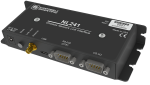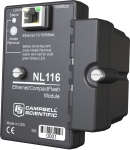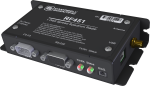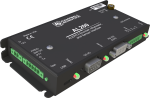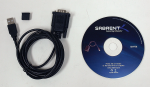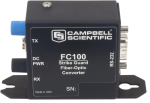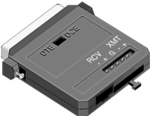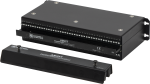
| In most applications, data and communications interactions with the datalogger are displayed and monitored on a base station computer running one... more |
| Our ethernet options allow Campbell Scientific dataloggers to communicate with a computer using TCP/IP. The local network or dedicated Internet connection... more |
| A multidrop network allows many dataloggers to be interrogated via a single cable. Individual multidrop modems are assigned unique addresses. more |
| Spread spectrum, UHF, VHF, or ELOS radio frequencies can be used to retrieve data from monitoring sites. We offer radios in... more |
| Short haul modems provide local communication between the data logger and a computer with an RS-232 serial port. The modem transmits... more |
| Telephone communication links require a Campbell Scientific field modem at the data logger site and a Hayes-compatible modem at the calling... more |
| Several types of data storage devices are available from Campbell Scientific. Data storage devices can be used for redundant data storage,... more |
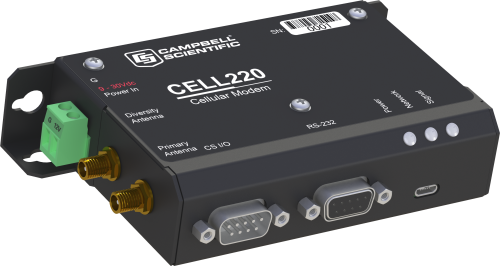
| Some of our communication devices require a peripheral to complete the connection. Devices that require a communication peripheral include cellular modems,... more |
Campbell Scientific offers a full range of communication devices. On-site peripherals include external data storage devices, PDAs, laptop or desktop computers, and displays.
Telemetry peripherals support communications between the datalogger and one or more computers. These peripherals allow the user to access remotely the datalogger's real-time data, stored data, and programming. Examples include short haul, multidrop, telephone, radio, and satellite modems.
Combinations of on-site and telemetry devices can be used in the same application for maximum flexibility, convenience, and reliability.
Click below for an overview that includes a telemetry comparison chart and compatibility charts: